Drone bill of materials (BOM): components, weight & cost
Before a drone or UAV ever flies, it exists as a bill of materials — a structured list of every part, with its quantity, weight and price. Getting the BOM right early is what keeps a design honest: it fixes the all-up mass that drives thrust, endurance and stability, and it tells you what the vehicle actually costs to build. This article breaks a drone down into its subsystems and shows how they add up into a single weight-and-cost picture.
The four subsystems of a drone
Almost every multirotor, VTOL or fixed-wing UAV can be organised into four groups. Keeping the BOM structured this way makes it easy to see where the mass and the money are going.
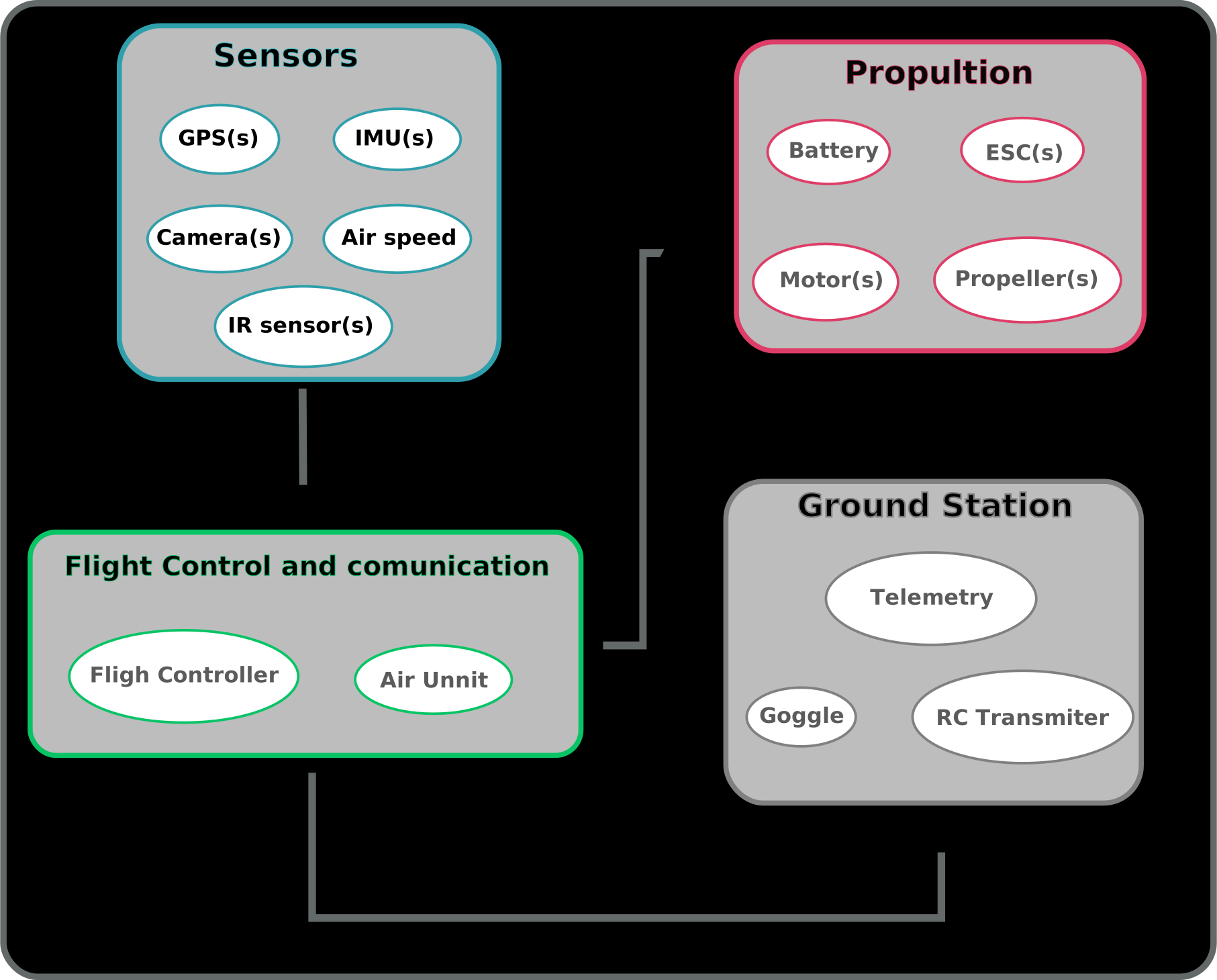
The diagram above shows how the parts hang together. Reading it as a tree makes the BOM almost write itself — each leaf is a line item:
- Propulsion & powertrain — motors, ESCs, propellers and the battery: the chain that converts stored energy into thrust, and the bulk of the vehicle's mass.
- Flight control & communication — the flight controller and air unit, plus the sensor suite (GPS, IMU, camera, airspeed, IR). This is the "brain and nerves" and the on-board half of the radio link.
- Ground station — telemetry radio, RC transmitter and goggles. It completes the system but stays on the ground, so it counts in cost, not in flight weight.
Add the airframe (frame, arms, mounts) that carries all of this, and you have the four groups the BOM is built from.
1. Propulsion
The system that turns electrical energy into thrust — usually the heaviest and most performance-critical group.
- Motor(s): brushless motors, sized for thrust and efficiency. Quantity matters — a quadcopter has four, a hexacopter six.
- ESC(s): electronic speed controllers, one per motor (or a single 4-in-1 board).
- Battery: the LiPo/Li-ion pack. Tracked separately because it is the component you trade most during sizing — see flight time and battery sizing.
- Propellers: sized from thrust and RPM — see how to size a propeller.
2. Avionic system
The "brain and nerves" — everything that senses, decides and communicates.
- Flight controller (FC): the autopilot board running the stabilisation and navigation.
- Sensors: GPS, IMU, barometer, camera, lidar, rangefinders — one line per sensor.
- Communication — air unit: the on-board radio link (video transmitter / air unit, receiver, antenna). This lives on the aircraft, so its weight counts toward flight mass.
3. Airframe
The structure that holds everything together — frame, arms, canopy, landing gear, mounts and fasteners. List each significant part so the structural mass is not underestimated.
4. Ground station
The equipment that stays on the ground: transmitter (radio controller), goggles or monitor, ground antenna and trackers. It is a real project cost, but it is not part of the vehicle's flight weight — so it should be counted in the price total and excluded from the mass that has to be lifted.
Rolling it up: weight and cost
Once every component has a quantity, a unit weight and a unit price, the BOM produces the numbers that matter:
- Vehicle weight without battery — the dry mass; your baseline for swapping battery packs.
- Vehicle total weight — dry mass + battery = the all-up weight (AUW) the propulsion must lift.
- Ground-station weight — tracked, but excluded from flight mass.
- Total price — vehicle + ground station = the true build cost.
Why weight and cost belong together
Weight and cost are coupled. A lighter motor or a carbon frame usually costs more; a bigger battery adds both mass and price while buying endurance. Keeping them in one BOM lets you make those trades with eyes open instead of discovering a 20 % mass overrun after the parts arrive. The all-up weight then feeds straight into thrust margin, propeller sizing and endurance.
Build your drone BOM in the browser
The free Weight & Cost (BOM) tool lets you enter every component across propulsion, avionics, airframe and ground station, and instantly get the total weight (with and without battery), total cost and a downloadable bill of materials (CSV). Need detailed CFD or a full design review of the result? Get in touch.
A practical BOM checklist
- List every component — small fasteners and connectors add up.
- Use quantities (4× motors, 4× ESCs) rather than pre-multiplied numbers, so it is easy to re-scale.
- Keep the battery on its own line to track dry vs all-up weight.
- Separate the ground station from flight mass.
- Revisit the BOM after every sizing change — it is a living document.
A BOM is a preliminary planning tool. Confirm real part weights from datasheets or a scale, and validate the final aerodynamic and propulsion design with test data or CFD.